History of the Château de Castelnaud
Making a day of it?The castle's own ticket is bought at the gate, so what is worth booking ahead is the rest of the day: the river under the walls, the valley from the air, a guided run out from Sarlat, or the rival castle across the water. Every option cancels free up to 24 hours before.
Check availabilityA Cathar lord, and two burnings
The first castle on this spur belonged to Bernard de Casnac, a lord of the Cathar faith, which in the early thirteenth century made him a target. In 1214 Simon de Montfort took the place during the Albigensian Crusade and installed a garrison. Bernard came back, retook it and hanged the men he found in it. The reply came in 1215, when the Archbishop of Bordeaux burned the castle down. What stands today is not that building: a new fortress went up on the site in the mid-thirteenth century.
The English century
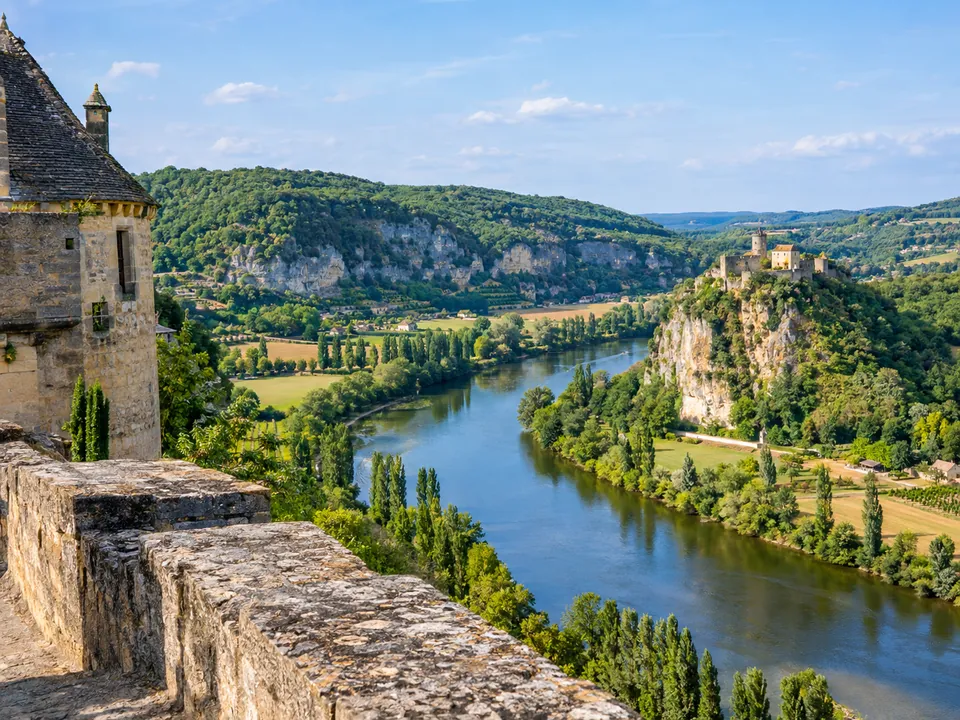
After the Treaty of Paris in 1259 the castle recognised English sovereignty, which fixed its position for the two hundred years that followed. The Dordogne was the frontier: English Guyenne on this side, the French crown’s lands on the other, with Beynac facing it from the far bank. In 1368 Magne de Castelnaud married Nompar de Caumont, and the Caumont lordship began. The war reached the walls in 1442. The siege, and the price the garrison took to leave.
The family that moved out
In 1489 the Caumonts built the Château des Milandes a short way off and made it their principal residence, keeping Castelnaud but no longer living in a fortress designed to be shot at. That is the pattern of the late fifteenth century compressed into one family: defence downgraded to comfort. Les Milandes is still there and is still visitable, under different ownership and with a twentieth-century story of its own. Les Milandes and Marqueyssac.
Sold, quarried, overgrown
The Revolution sold Castelnaud as a bien national in 1789, and the nineteenth century treated it as what it had become: a source of dressed stone. The artillery tower and the south range lost their upper parts, and scrub took the rest. Photographs from before the restoration show a ruin with trees growing out of it.
The restoration, and who runs it now
The castle was classé monument historique in 1966, with the listing extended in 1980. The Rossillon family bought it and began the restoration in the mid-1960s — French Wikipedia dates the purchase and the start of the works to 1965, under Philippe Rossillon. His son Kléber Rossillon opened it to the public in 1985 and runs it today within a group of twelve sites, which also holds the Jardins de Marqueyssac. The group gives attendance at about 230,000 a year; French Wikipedia gives 245,000 for 2022. Around a quarter of a million, either way. Whether it earns the visit.
Château, châteaux, château fort
One point of vocabulary, since it comes up constantly. Château is the singular and châteaux the plural. In French the word covers both a fortress and a grand country house, which is why the Loire’s palaces and this military spur carry the same label; the term for the fortified kind is château fort, and that is what Castelnaud is. Ask which is the most famous château in France and the answer is almost always Versailles, with Chambord next — both palaces, and neither built to be besieged.
See the other side of the frontier
Entry to the Château de Beynac, which held for the French crown while Castelnaud held for England: self-guided, about an hour, with the Richard the Lionheart and Eleanor of Aquitaine exhibition. From around seventeen euros, free cancellation up to 24 hours before.
Frequently asked questions
How old is the Château de Castelnaud?
The first castle here dates from the 12th century. It was burned in 1215 and rebuilt in the mid-13th century, so most of what stands today is that later fortress and its subsequent additions. What survives, room by room.
Who owns the Château de Castelnaud?
The Rossillon family, who bought the ruin and began restoring it in the mid-1960s. Kléber Rossillon opened it to the public in 1985 and runs it today within a group of twelve sites that also includes the Jardins de Marqueyssac. The combined ticket.
What is the difference between château and châteaux?
Château is the singular, châteaux the plural. In French the word covers both a fortress and a grand country house; a fortified one like Castelnaud is a château fort.
Why was Castelnaud built facing Beynac?
The Dordogne was the frontier between English Guyenne and the French crown’s lands. Castelnaud held for the English, Beynac for the French, though no battle between the two is documented. How the two compare today.