What to see at the Château de Castelnaud
Making a day of it?The castle's own ticket is bought at the gate, so what is worth booking ahead is the rest of the day: the river under the walls, the valley from the air, a guided run out from Sarlat, or the rival castle across the water. Every option cancels free up to 24 hours before.
Check availabilityThe route, in the order you walk it
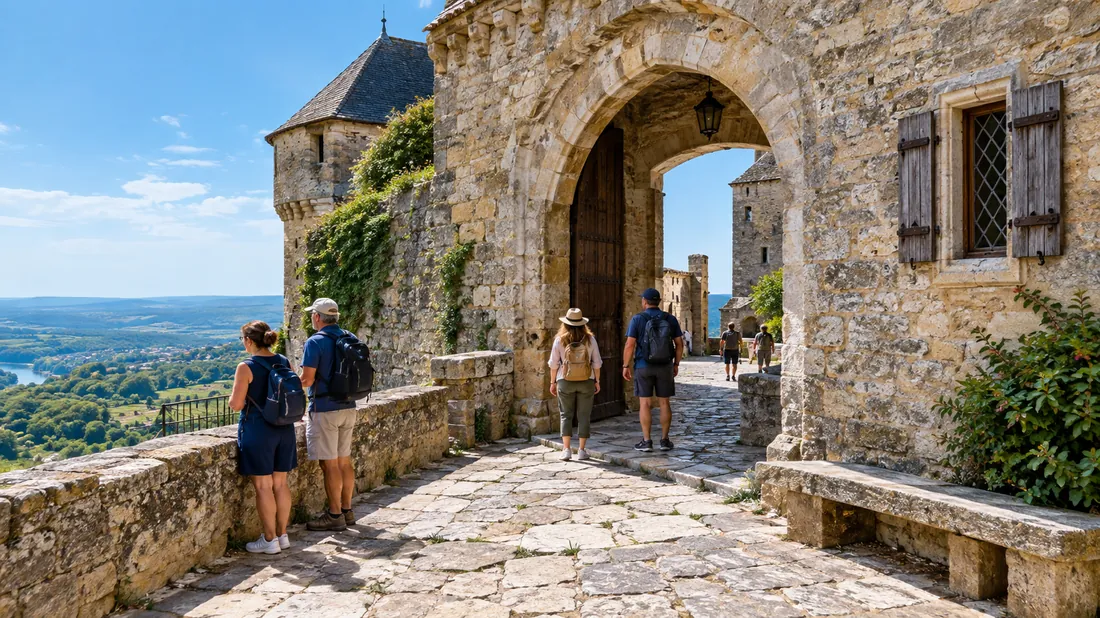
- The barbican — the outwork you pass through first, and one of the two places the castle names as accessible to visitors with reduced mobility.
- The lower and upper baileys — the open ground the curtain wall encloses, and the best place to read the shape of the fortress.
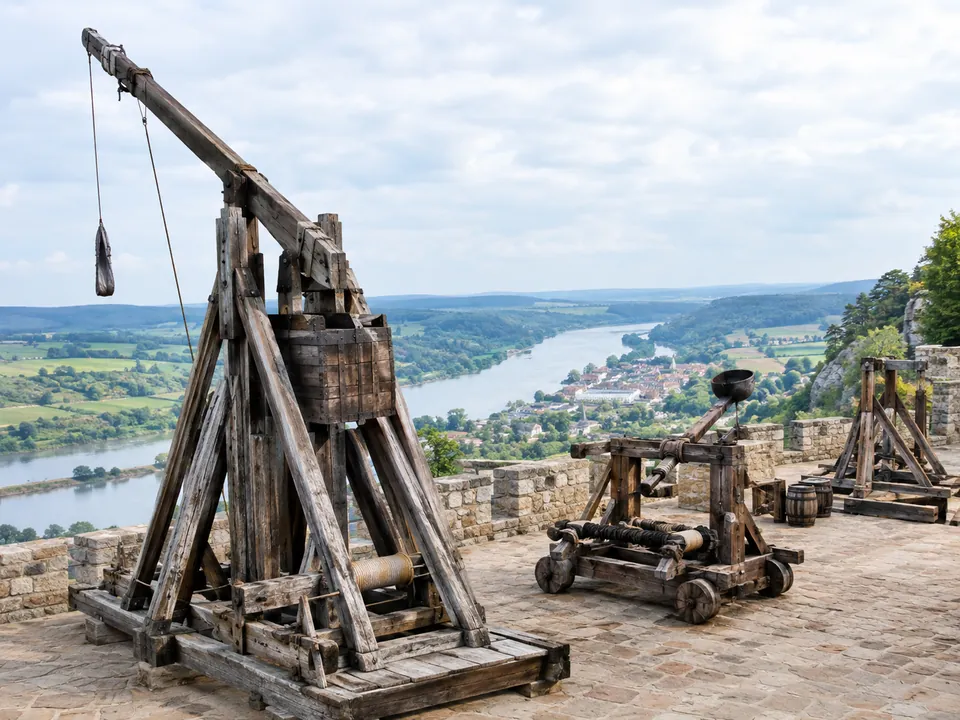
- The bastion — full-scale reconstructed war machines standing in attack positions: trebuchet, mangonneau, pierrière, bombarde and bricole. These are not the machines that get fired.
- The living quarters — with the wall painting of the Nine Worthies, the nine exemplary heroes of medieval chivalry.
- The weapons room, the kitchen and the forge — where the museum collection and the building stop being two separate things.
- The artillery tower and the curtain wall — quarried for stone after 1789 and rebuilt in the restoration.
- The keep, and then the view over the Dordogne to Beynac on the far bank.
- The medieval garden — about twenty minutes on its own guided visit, and the flattest ground inside the walls.
The museum inside the castle
The Musée de la guerre au Moyen Âge is not a room off the route; it is what fills the castle. The castle’s own figure is more than 250 authentic weapons and pieces of armour from across Europe, with a separate room of scale models of siege engines at 1:10 and 1:20. The collection, and what makes it unusual.
The screens, and the siege
Six videos run inside the castle: how it was built, how a siege worked, the equipment, and the restoration works that brought the ruin back. There is a videogame about freeing an imprisoned character, which reliably holds a child for longer than the label suggests. The one nobody should walk past is the model of the 1442 siege, staged with light and sound and ending with the English leaving. What happened in those three weeks.
What it costs to get in, and what it does not
All of the above is inside the castle’s own ticket, which the castle sells itself, every day of the year, with no slot to reserve. The one thing it does not buy is the valley the castle was built to control, and that is the part of a Dordogne day that has to be arranged. The 2026 tariff and what the ticket covers, or the whole visit explained end to end.
See the same walls from underneath
Three hours on the Dordogne from Vitrac, passing directly beneath the castle: canoe or kayak, paddles, life jackets, insurance, free parking at the base and the shuttle back. From around twenty-nine euros, free cancellation up to 24 hours before.
Frequently asked questions
What is inside the Château de Castelnaud?
A medieval-warfare museum, in a restored fortress: more than 250 weapons and pieces of armour, full-size siege engines on the bastion, six videos, a light-and-sound model of the 1442 siege, and rooms from the forge to the keep. The collection in detail.
Is there an audio guide at the Château de Castelnaud?
No. A printed tour booklet is free at the entrance in twelve languages and in Braille, and a children’s games booklet is free for ages 7 to 12 while stocks last.
What is the Nine Worthies painting?
A wall painting in the living quarters showing the nine exemplary heroes of medieval chivalry, three pagan, three Jewish and three Christian — a standard subject of the period, and one of the few decorative survivals in the castle.
Is the Château de Castelnaud accessible?
The castle states that its layout and its many narrow staircases make the museum difficult for visitors with reduced mobility, but that the viewpoint and the barbican are accessible, and it offers a free 360° virtual visit. Getting as close as possible by car.