The siege of Castelnaud, 1442
Making a day of it?The castle's own ticket is bought at the gate, so what is worth booking ahead is the rest of the day: the river under the walls, the valley from the air, a guided run out from Sarlat, or the rival castle across the water. Every option cancels free up to 24 hours before.
Check availabilityWhat happened
By 1442 the Hundred Years War was in its last stretch and Charles VII was taking back the south-west castle by castle. Castelnaud was one of them: an English-aligned fortress on the frontier river, holding for Henry VI. The French force sat in front of it for three weeks. Then, rather than an assault and a sack, the thing ended commercially. The besieged handed over the fortress for 400 gold coins and walked out. For a war fought largely by garrisons whose loyalty had a price, that is an entirely ordinary ending, and it is the reason the building survived to be quarried three centuries later rather than burned in the fifteenth. The full chronology.
The name this site does not print
A commander is confidently named for the besieging force in a good deal of writing about Castelnaud — Dunois, usually. No source this site was able to check supports it, so no commander is named here. That restraint is worth stating plainly, because it is the sort of detail that travels from one article to the next without ever acquiring a footnote.
Three weeks, 400 gold coins, and no storming of the walls.
Seeing it inside the castle
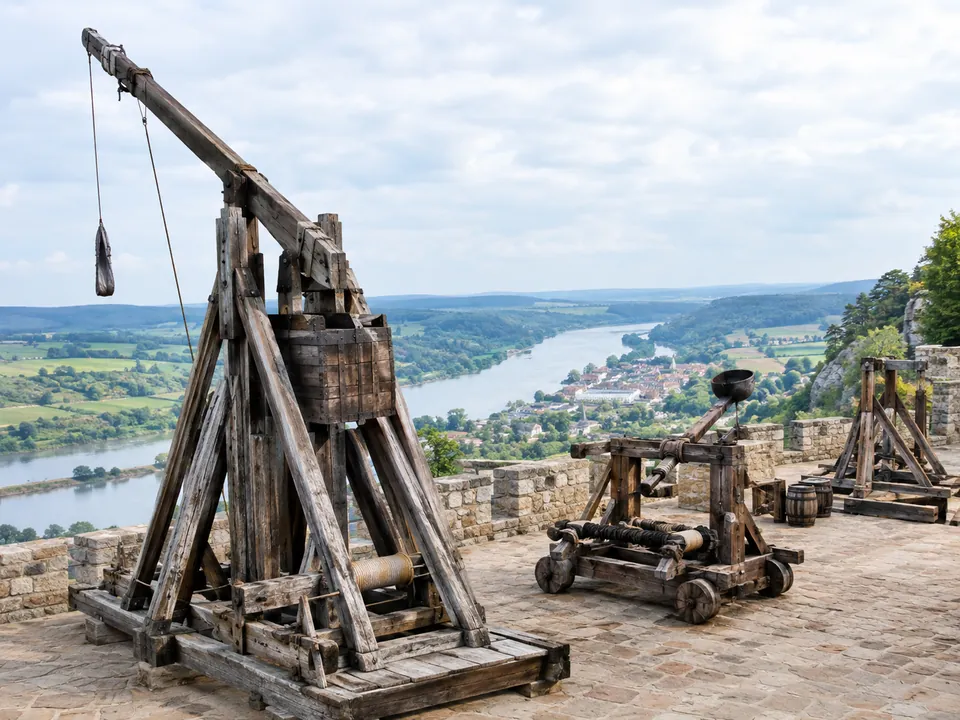
The siege is the set piece of the visit. A model of the 1442 siege, staged with light and sound, plays the three weeks out and ends with the English leaving, and it sits in a castle that spends the rest of the hour explaining how such a thing was done: full-size engines along the bastion in attack positions, scale models at 1:10 and 1:20, six videos on construction and siege warfare, and more than 250 weapons and pieces of armour. The collection in detail, or the machine that actually gets fired.
The siege that never happened
Beynac, on the far bank, held for the French crown throughout. It is a short step from that to the story of two garrisons shelling each other across the water, and the step is not supported: no battle between the two castles is documented, and no source gives a distance between them. The 1442 siege was ordered from the French court, not launched from the opposite hill. The two castles, compared honestly.
Stand on the other bank
Entry to the Château de Beynac, which held for the French crown while this one held for England, with the Richard the Lionheart and Eleanor of Aquitaine exhibition. Self-guided, about an hour. From around seventeen euros, free cancellation up to 24 hours before.
Frequently asked questions
What happened at Castelnaud in 1442?
Charles VII ordered a siege of the castle, then held by a garrison loyal to Henry VI of England. After three weeks the besieged surrendered the fortress in exchange for 400 gold coins. The wider chronology.
Who led the siege of Castelnaud?
No surviving source this site could check names the commander. The name that circulates online has no citation behind it, so it is not repeated here.
Was Castelnaud ever attacked by Beynac?
There is no documented battle between the two castles. They held for opposite sides of the Hundred Years War frontier, but the exchange-of-fire story is legend. Which to visit.
Can you see the siege re-created at the castle?
Yes — a light-and-sound model inside the castle replays the 1442 siege and ends with the English leaving, on the same ticket as the museum and the bastion. What else is inside.