The Musée de la guerre au Moyen Âge
Making a day of it?The castle's own ticket is bought at the gate, so what is worth booking ahead is the rest of the day: the river under the walls, the valley from the air, a guided run out from Sarlat, or the rival castle across the water. Every option cancels free up to 24 hours before.
Check availabilityThe collection
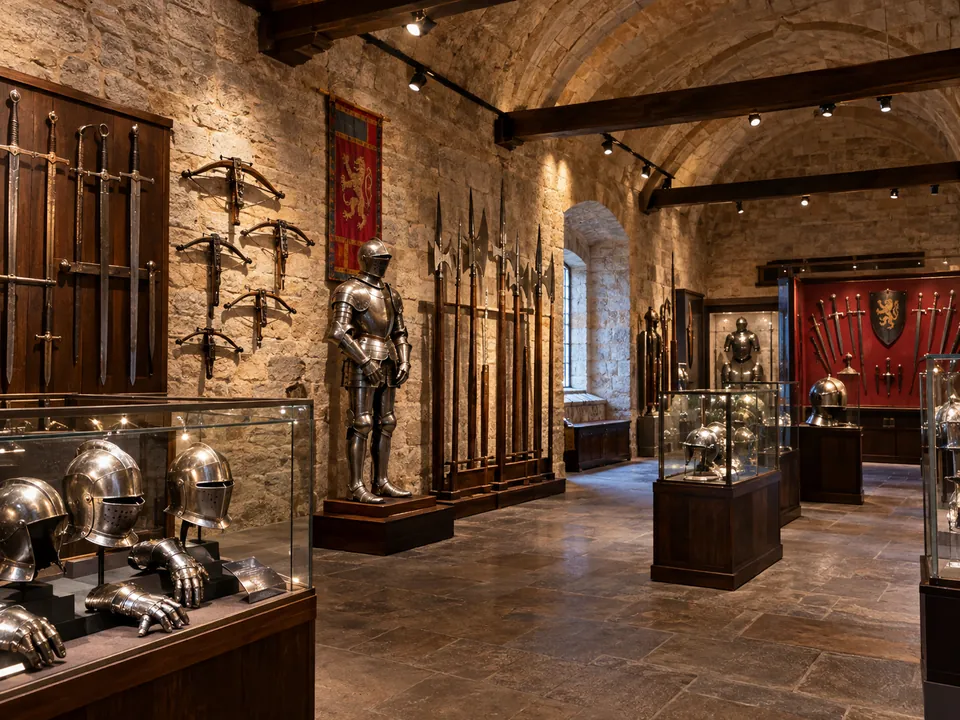
The castle states more than 250 authentic weapons and pieces of armour, gathered from across Europe. French Wikipedia gives a larger count, about 300 pieces spanning the thirteenth to the seventeenth century, and goes further: it calls this the second collection of its kind in France, behind only the Musée de l’Armée in Paris. That ranking is Wikipedia’s and is attributed here rather than asserted, but the scale of what is on the walls is not in dispute. The pieces are displayed in the rooms they belong to — the weapons room, the living quarters, the artillery tower — rather than in a separate gallery bolted onto a castle.
The engines on the bastion
Along the bastion stand full-scale reconstructed war machines, set in attack positions as they would have been ranged against these walls. The castle’s brochure names five: the trebuchet, the mangonneau, the pierrière, the bombarde and the bricole — two counterweight and traction machines, a stone-thrower, an early gunpowder piece and a light swing-beam engine, which together read as a century of siege technology laid out in one line. These full-size engines are not the ones fired in the daily demonstration. The machine that is actually fired is a separate trebuchet built at one-third scale, and the confusion between the two is the most repeated mistake made about this castle. How the firing works.
The models, and the 1442 siege
A room of its own holds scale models of siege engines at 1:10 and 1:20, which is where the mechanics become legible: the counterweight, the sling, the release. The other model in the castle is the set piece. A light-and-sound reconstruction of the 1442 siege plays out the three weeks Charles VII’s forces spent in front of these walls and ends with the English leaving. The siege itself, and what the sources actually say.
The six videos
Screens through the castle cover four subjects: how the fortress was built, how a siege worked, the equipment a fighting man carried, and the restoration works that turned a quarried ruin back into a building. A videogame about freeing an imprisoned character sits alongside them. None of it is long, and all of it is the reason the signposted hour stretches. How long a visit really takes.
There is no audio guide. The printed tour booklet is free at the entrance in twelve languages and in Braille, and the children’s games booklet is free for ages 7 to 12 while stocks last. The route, room by room.
The other castle, and the other kind of day
Castelnaud’s ticket is sold by the castle itself, at the gate and on its own site, every day of the year. Across the river, Beynac is the opposite proposition — preserved and furnished rather than restored and armed, with seventeenth-century apartments and a thirteenth-century kitchen — and its entry is the one castle interior in this valley that can be held in advance. Visitors who want the whole story usually do both. The comparison in full.
Book the other half of the story
Entry to the Château de Beynac on the far bank, with the exhibition on Richard the Lionheart and Eleanor of Aquitaine and the bookshop. Self-guided, about an hour, valid one day from first use, under-10s free. From around seventeen euros, free cancellation up to 24 hours before.
Frequently asked questions
What is the museum at the Château de Castelnaud?
The Musée de la guerre au Moyen Âge, a medieval-warfare collection housed in the castle itself: more than 250 authentic weapons and pieces of armour from across Europe, plus siege engines, scale models and six videos. Where each part sits on the route.
How many weapons are in the Castelnaud collection?
The castle gives the figure as more than 250 authentic weapons and pieces of armour. French Wikipedia puts it at about 300 pieces from the 13th to the 17th century and ranks the collection second in France after the Musée de l’Armée.
Are the siege engines at Castelnaud real size?
The ones standing on the bastion are full scale, in attack positions: trebuchet, mangonneau, pierrière, bombarde and bricole. The machine used in the firing demonstration is a different one, built at one-third scale. The difference explained.
Is the Castelnaud museum included in the castle ticket?
Yes — the museum is the castle. One ticket covers the fortress, the collection, the bastion, the videos and the siege model, and the castle sells it itself, every day of the year. What the ticket covers.